A guide to incorporating
Moving assets into a corporation.
You’ve built a business as a sole proprietor. Now you want to incorporate and keep growing. Here’s how to move what you’ve built into your new company, and what that means for your taxes.
First, you create a company.
Let’s call it You, Inc. Your corporation is a separate entity from you. It can own things, earn money and pay tax.
Incorporating can let you leave earnings in the company to grow the business. The tax result depends on what the company earns and how much you take out personally.
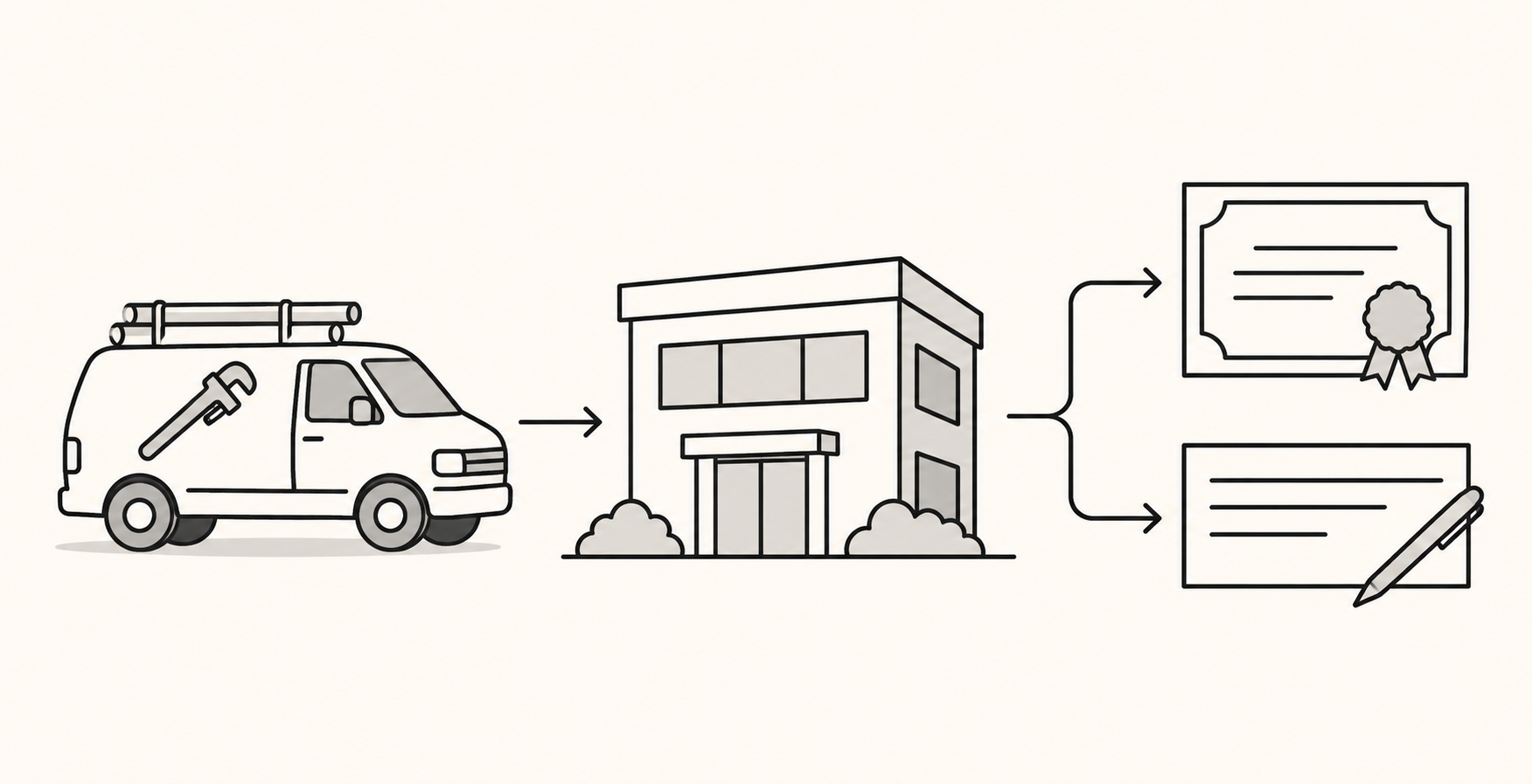
Next, you move your business into You, Inc. That might include equipment, inventory and the value you’ve built through your customers and reputation.
Here’s the catch.
Even though you own the company, it’s a separate entity. Moving your business to it is generally treated as a sale at market value. That can mean tax on the gain, even if you haven’t received cash.
Imagine you own a plumbing business. You built its reputation and customer relationships from scratch. Assume that goodwill is worth $1 million and its tax cost is $0. A transfer at full value could leave you with a $1 million gain to report.
You can choose a different tax price.
This is where a Section 85 rollover comes in. It’s a tool that lets you and your company choose an amount to use as the sale price for tax purposes. It’s called the elected amount.
For our simple example, the choice can range from the $0 tax cost to the $1 million market value. The limits depend on the assets and what you receive, so your accountant will work out the range for your business.
In return for the business, your company gives you shares. It can also give you an IOU, a promise to pay you later. The amount of cash, IOU or debt taken over affects the amount you can elect.
Let’s look at three choices.
Each example uses the plumbing business’s $1 million of goodwill with a $0 tax cost. These amounts are gains, not tax bills. We assume the company issues shares and takes over no debt. Your assets need separate values and elections.
Choose $0
You defer the gain and receive the full $1 million of value in shares. There is no IOU in this example. You owe little or no tax on this transfer today, but the company does not owe you money it can repay later. If you need company earnings personally, salary or dividends may be taxable. For property with a zero tax cost, the CRA requires a nominal elected amount.
Choose $1 million
You report a $1 million capital gain now. Subject to the rules and shares being issued, the company can owe you up to $1 million as an IOU. Repayment of the principal of a genuine debt is generally not taxed again as salary or dividends. The trade-off: you need cash to pay the tax now, and the company needs cash before it can repay you.
Choose $300,000
You report a $300,000 capital gain now. The company gives you a $300,000 IOU and $700,000 of share value. You pay tax on part of the gain now and defer the rest. When the company has cash, it can repay the IOU principal without that repayment itself being a dividend. This balances the immediate tax bill against money you may want to withdraw later.
There’s no one right number. The choice depends on the cash you need, the tax you can pay now, the company’s ability to repay you and your plans for the business.
Why pay tax on a gain now?
Different kinds of income are taxed differently. Salary is personal income. Dividends come from company profits and have their own personal tax rules and credits. A capital gain is different again: generally, half is included in taxable income. Your actual rate depends on your other income, province, dividend type and the rules in force.
By choosing a higher amount for the plumbing business’s goodwill, you can recognize a capital gain now and receive a larger IOU. When the company repays that debt, the principal is generally not taxed again. That can cost less personally than receiving the same cash as taxable salary or dividends later.
But it is not a guaranteed saving. The gain creates a tax bill now; timing, corporate tax, future tax rates and whether the company can repay the debt all matter. Compare the full after-tax result with your accountant.
What the different rates can mean.
At Ontario’s highest personal bracket in 2026, salary is taxed at 53.53%, a non-eligible dividend at 47.74%, and a capital gain at about 26.77% of the gain. These are marginal rates, applying to income already in the top bracket, not the average tax on everyone’s income.1
For illustration, if every dollar falls in that top bracket, a $1 million non-eligible dividend would mean roughly $477,400 of personal tax. A $1 million capital gain would mean roughly $267,650, leaving about $209,750 more after personal tax. Those are marginal-rate illustrations, not estimates of your actual return.1
$209,750 less personal tax in this illustration. Corporate tax and other effects are excluded.
In the rollover example, the gain is recognized on the transfer. If the company later repays a genuine $1 million IOU, repayment of principal is generally not taxed again. It needs the cash to do so. This comparison excludes corporate tax, financing costs and other effects; salary may be deductible to the company, while dividends are paid from after-tax profits. It does not prove the rollover saves that amount overall.2
What if the business is worth less later?
You pay the tax on the gain for the year of the transfer, even if the business later loses value or closes and the company cannot repay the IOU. A later loss may provide tax relief, but its treatment and timing depend on the facts. A refund of the earlier tax is not guaranteed.
What happens later?
The tax you defer doesn’t disappear. Your company’s tax cost reflects the elected amount, so a later sale of the assets can create a gain. Your shares have their own tax cost, and selling shares or taking money out of the company can have separate tax consequences.
If you plan to sell the company one day, ask about the lifetime capital gains exemption. It may be available on a qualifying share sale, but it depends on the company and your circumstances.
Planning to sell the company?
The lifetime capital gains exemption (LCGE) can shelter some or all of a gain on qualifying small business corporation shares. It applies to an eligible share sale, subject to ownership, asset and other conditions, and your remaining lifetime limit. It does not automatically shelter the company’s sale of its assets.3
The elected amount and mix of shares and IOU affect the shares’ tax cost and value, and therefore the gain you may have on a later share sale. Paying more tax now can reduce the value left in shares; deferring more can leave more potential gain in shares that may qualify later. A future exemption is not guaranteed, so weigh a possible sale against cash you want to withdraw before then.
May qualify for the LCGE
No automatic share exemption
What about the van and equipment?
The plumbing business may also transfer equipment and vehicles. These are depreciable property. Capital cost allowance (CCA) is the tax deduction that spreads their cost over time. The remaining amount in the tax pool is called undepreciated capital cost (UCC).4
Choosing an amount for depreciable property can affect tax now, including a possible recovery of CCA previously claimed, called recapture, and the corporation’s future CCA deductions. The limits depend on the particular property and its pool. The $0 goodwill examples above do not work as a blanket price for the van or equipment. Work through each asset with your accountant.2
The terms, in plain language.
- Elected amount
- The amount you and the company choose for tax when transferring an eligible asset.
- Fair market value
- What an asset would sell for between independent parties.
- Tax cost
- The amount used to calculate a gain or loss for tax. It may differ from market value.
- Capital gain
- The increase in value recognized when capital property is sold or transferred.
- Promissory note (IOU)
- A written promise from the company to pay you a specified amount.
- Shares
- Your ownership interest in the corporation.
Ready to make the move?
Start by working out what you’re transferring and what it’s worth. Your accountant and lawyer can help choose the amount, prepare the transfer and shares, and file the joint election.
For an individual transferring eligible property, the election is generally made on Form T2057. It’s due by the earlier of your and your company’s tax-return filing deadlines for the years that include the transfer.
 Try the rollover calculator ↗
This is a simplified example. The rules vary by asset and transaction. Read the CRA’s guide and discuss your plans with an accountant.
Sources
- 2026 Ontario combined top marginal rates: Fidelity 2026 tax facts. Capital gains inclusion: Income Tax Act, section 38. Dividend gross-up and credits: section 82 and section 121.
- Income Tax Act, section 85 and CRA’s transfer guide.
- Income Tax Act, section 110.6, including the definition of qualifying shares and the capital gains deduction.
- Income Tax Act, section 20(1)(a); section 13 for recapture and UCC; and Income Tax Regulations, section 1100 for CCA.